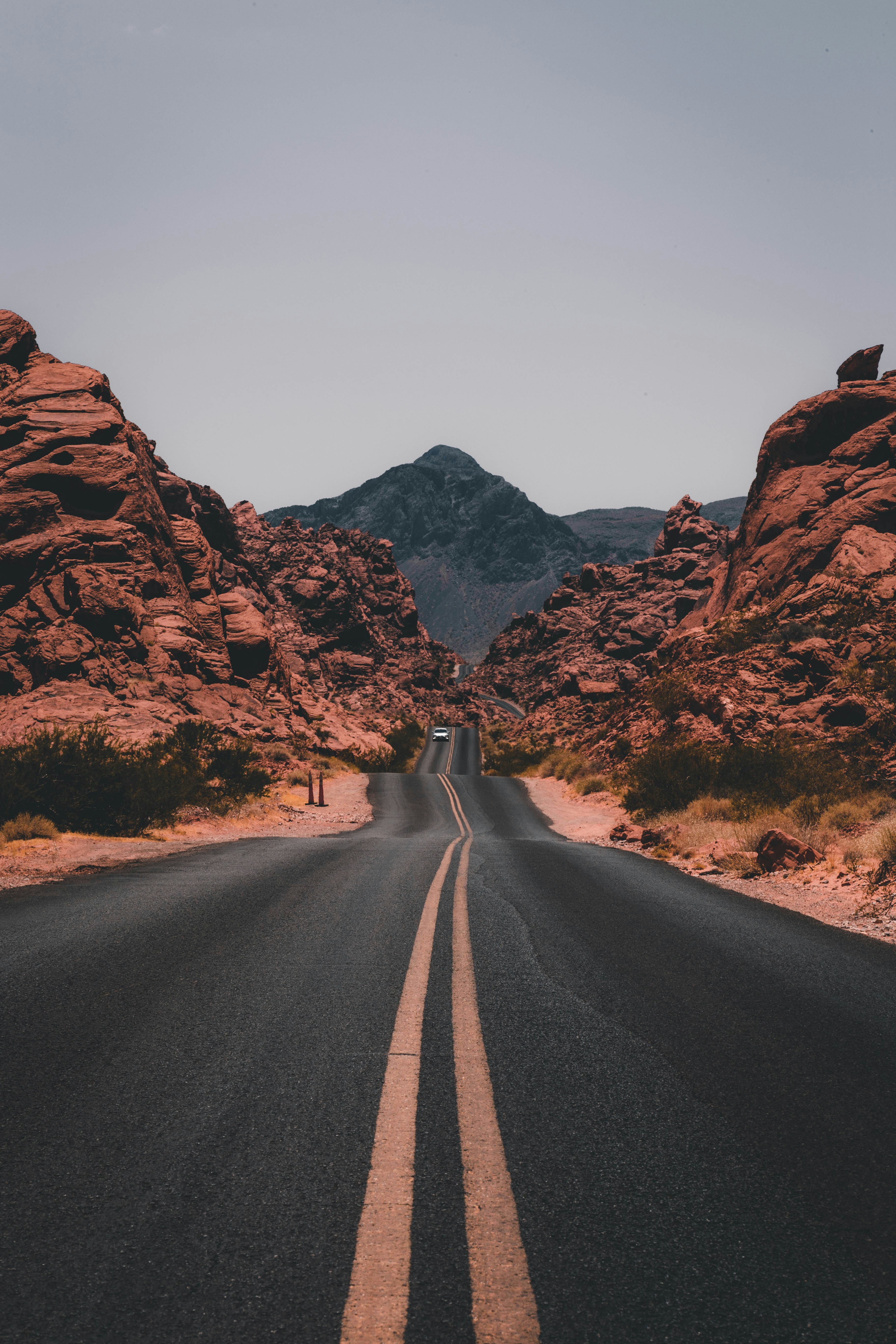
Fossil Rock is one of the UAE's best-known geological landmarks. Rising beside the dunes near Mleiha in Sharjah, the outcrop contains marine fossils that record a time when this part of Arabia lay beneath the sea.
Official tourism sources describe the formation as Fossil Rock, while the mountain is commonly known as Jebel Mleiha, Jebel Maleihah or Jebel Mleiha. The variations reflect different English spellings of the Arabic place name.
Location note
Fossil Rock is in the Central Region of the Emirate of Sharjah, close to Mleiha and the Mleiha Archaeological Centre. It is not in Ras Al Khaimah, although it belongs to the broader chain of isolated ridges and foothills associated with the UAE's eastern mountain landscape.
Where is Fossil Rock?
The outcrop lies near the Sharjah–Kalba road and is surrounded by red and orange dunes. From a distance, it appears as a long rocky wall rising abruptly from the desert.
The contrast between limestone and sand makes it a popular destination for hiking, photography, desert driving and guided geological trips.
Fossil Rock is not only a mountain in the desert. It is a surviving piece of an ancient seabed.
Jebel Mleiha and Fossil Rock
“Jebel” means mountain in Arabic. Jebel Mleiha is the formal geographical name commonly associated with the formation, while “Fossil Rock” describes the marine fossils visible in parts of the outcrop.
It is sometimes said that the mountain forms part of a continuous ridge extending from Ras Al Khaimah towards Al Ain. The geology of the UAE is more complicated than one uninterrupted ridge, however. Fossil Rock is better understood as one of several sedimentary outcrops and foothill structures lying west of the main Hajar Mountains.
The fossil-bearing layers
Fossils are not distributed evenly through every part of the mountain. They occur within particular sedimentary layers formed under conditions suitable for marine life and fossil preservation.
Similar fossil-bearing beds may continue along parts of the outcrop, but erosion, broken surfaces, sand cover and difficult access can make them hard to see.
A fossil layer can be obvious at one location and almost invisible only a short distance away. The angle of the rock and the way it has weathered also affect what a visitor can recognise.
A popular fossil destination
Fossil Rock became widely known because marine fossils could be seen in an accessible desert setting. Official Sharjah tourism material continues to describe marine fossils embedded in the formation and promotes guided hiking and geological experiences in the area.
The site is therefore not merely a historical name. Fossils remain part of its recognised geological significance, even though individual visitors may find them difficult to locate.
Look carefully rather than widely
Fossils may appear as small curved shells, spirals, fragments or cross-sections. Side lighting often reveals shapes that disappear under bright overhead sun.
Collecting, hammering and lost context
Long-time visitors have expressed concern that repeated hammering and fossil collecting have damaged some of the most accessible surfaces. Where people cut into fossil-bearing layers, visible specimens can disappear and the geological context is permanently altered.
The claim that the layer has been almost completely destroyed is difficult to verify without a formal condition survey. It is therefore better treated as a serious firsthand concern rather than a confirmed assessment of the entire mountain.
What is beyond doubt is that every removed fossil leaves less information for future visitors, students and geologists.
Do not use a hammer
Do not chip, carve or remove fossils from Fossil Rock. Photograph fossils in place and leave the rock surface intact. Collecting may also conflict with local conservation, heritage or land-management rules.
Marine gastropods
Some of the most recognisable fossils at Fossil Rock are commonly described as gastropods. Gastropods are molluscs that include snails, limpets and slugs.
The name refers to a broad and diverse group. Modern gastropods live in the sea, freshwater and on land, and their shells range from simple cap-like forms to tightly coiled spirals.
At Fossil Rock, the gastropod fossils are marine. They represent animals that lived on or near the seafloor when this landscape formed beneath seawater.
- Coiled shell shapes
- Curved internal moulds
- Broken shell fragments
- Cross-sections through limestone
- Marine sediment surrounding fossils
- Weathered cavities where shells dissolved
When seawater covered the landscape
The marine fossils show that the sediment forming Fossil Rock accumulated in an ancient sea. Official descriptions of the Mleiha landscape refer to prehistoric marine fossils and fossil beds millions of years old.
Later geological uplift and erosion exposed the former marine sediments, while wind deposited the desert dunes that now surround the outcrop.
The result is one of the UAE's most dramatic geological contrasts: marine limestone rising from a modern arid desert.
How old is the gastropod group?
Gastropods have a very long fossil history. Forms assigned to the group are known from the early Palaeozoic, including the Cambrian Period more than 500 million years ago.
That does not mean the gastropods at Fossil Rock are 500 million years old. It means the broader gastropod lineage has existed for that length of time. The age of fossils at a particular site depends on the geological formation in which they occur.
Fossil Rock is generally associated with much younger marine sedimentary rocks than the earliest gastropod fossils. Popular regional descriptions commonly place its fossil-bearing beds in the Cretaceous, when shallow seas covered parts of the area.
Group age and fossil age are different
“Gastropods originated more than 500 million years ago” describes the history of the animal group. It does not date an individual shell fossil found at Mleiha.
How to study fossils responsibly
Fossils are most useful when left in their original layer. Their position, orientation and relationship with surrounding rock can reveal more than a detached specimen.
- Photograph the entire fossil-bearing surface.
- Use a ruler, coin or trekking pole for scale.
- Take close-up photographs from several angles.
- Do not hammer or scratch the rock.
- Do not pour chemicals or water onto the fossil.
- Do not remove loose specimens without permission.
- Share unusual finds with a qualified geologist or the visitor centre.
Avoid publishing exact coordinates for vulnerable fossil concentrations. A location that appears harmless when shared with one person can quickly be damaged when circulated widely.
Hiking at Fossil Rock
Sharjah's official hiking information describes a route of approximately six kilometres, with rocky ground, dunes and steep sections. Some sections may involve hands-on movement over rock.
There is little or no shade, so the route is best attempted during cooler weather and at an appropriate time of day. Carry sufficient water, use offline navigation and avoid walking beneath unstable rock faces.
- Supportive footwear
- Drinking water and reserve
- Sun protection
- Offline route
- Charged phone
- Headlamp
- First-aid kit
- No geological hammer
Final thoughts
Fossil Rock remains one of the UAE's most accessible reminders that Arabia has not always been a desert. Its marine fossils connect the present landscape with an ancient sea and with animal groups whose history extends back hundreds of millions of years.
That accessibility also creates responsibility. The value of the site lies in fossils remaining visible in the rock—not disappearing into private collections.
The best fossil hunter leaves with photographs, questions and the rock exactly where it was found.
Further reading
- Visit Sharjah: Fossil Rock
- Visit Sharjah: Mleiha Fossil Rock Hiking Trail
- UAE Ministry of Climate Change and Environment: Fossil Rock

DubaiHiking.org Editorial Team
DubaiHiking.org shares UAE hiking stories, geological discoveries and responsible outdoor knowledge from Sharjah, Ras Al Khaimah and the wider Hajar region.